

Fence repair pricing comes down to what actually failed, not how rough the fence looks from the curb. A run of snapped boards can honestly cost less than fixing one post that rotted below grade. One job is basically carpentry, the other is more like excavation, and that difference catches people off guard a lot.
As a leading fence company working as fence contractors across Pierce and Thurston County, the first thing we do on any repair call in Tacoma, WA, is sort the damage into categories before anyone talks numbers. What follows is how we price each type and what tends to push a quote up or down within it.
Why Fence Repair Quotes Vary So Much Between Contractors
Two contractors can look at the same twenty feet of damaged fence and come back with quotes that are pretty far apart. The gap is usually scope, not margin, if we’re being honest. One priced the visible damage. The other priced the visible damage plus the post holding it up, which was soft at the ground line and would’ve failed within a year anyway.
That gap in scope is part of why the cost of installing a fence can look so different from one quote to the next, even on jobs that seem similar on paper. This is why we walk the whole line instead of just standing at the damaged section. A repair scoped from a photo or a phone call is going to miss anything below grade, and below grade is where fences around here actually fail.
When you’re collecting quotes, ask each contractor what they checked at the base of the posts. The answer tells you which quote you’re really comparing.
What Drives the Cost of Post Repairs
Posts are the most expensive repair per unit and also the most common one we handle out here. The work isn’t really the post itself, that part’s cheap. The work is getting the old one out, since a post set in concrete twenty years ago comes out as basically a block with wood in the middle.
That block has to be dug, broken, and hauled, and ground conditions change the effort a lot. Saturated winter soil digs very differently than packed summer clay, for what it’s worth.
If you’re leaning toward chain link fencing for a section of the yard instead, by the way, post work there tends to be a bit lighter since the fabric isn’t carrying the same load as a wood panel.
Access is the other factor people don’t really think about. A post on an open back fence line is pretty straightforward. A post behind a shed, under a mature laurel, or against a retaining wall takes a lot longer for the same result, and pricing just reflects that.
Corner posts and gate posts cost more again, since both carry loads the line posts don’t and both need setting to a higher standard. If a customer in South Tacoma calls about a sagging gate, the gate hardware is rarely the real bill. The post it hangs on usually is.
What Panel and Board Repairs Usually Involve
Board-level damage is the cheapest category and also the fastest to finish. Individual cedar boards come out and go back in without touching the rails or the posts at all. Cost pretty much tracks the number of boards and not much else.
Storm damage to a stretch of pickets, a section a vehicle backed into, or boards a dog worked loose, all of that falls here, and most of these are half-day jobs. Honestly, material changes the picture more than the damage does. Vinyl panels usually get replaced as whole sections rather than piece by piece, which raises the unit cost but shortens the labor.
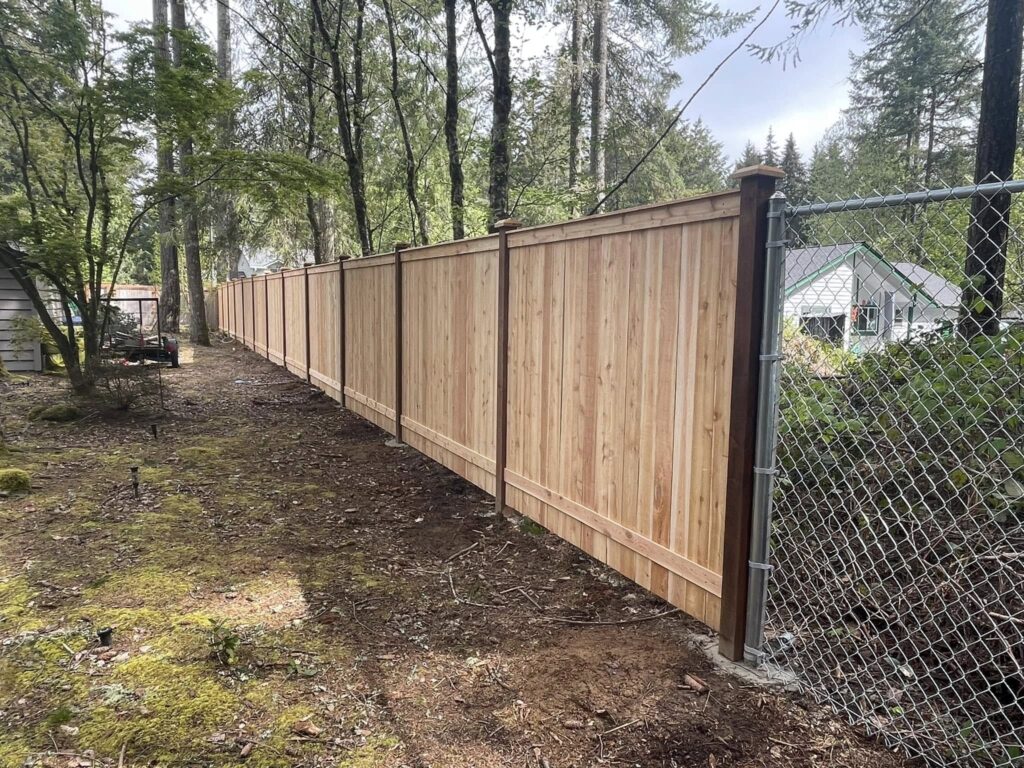
Chain link repairs are different again, since the fabric can often be patched or re-stretched instead of replaced, and the mesh is just more forgiving of impact than wood or vinyl. If you’re weighing a repair against switching materials, the cost of a chain link fence tends to come out lower over its life, and it’s worth having that number next to your repair quote before you decide.
Noticed a few boards knocked loose or a rail that’s starting to sag? Give us a call at (253) 219-6682, and we’ll take a look before it turns into a bigger repair.
How Rot Damage Is Priced Differently From Impact Damage
Impact damage is bounded, pretty much by definition. A car hit a fence, a tree came down, and the affected length is visible and finite. We can measure it, quote it, and feel good about the number holding, since nothing outside that section was really involved.
Rot doesn’t work that way, and honestly this is the biggest reason repair quotes get revised partway through. Rot spreads along the grain and travels through contact points, so a rail that looks sound where it meets a solid post may be soft where it meets a failing one.
We probe beyond the obviously damaged wood before quoting, and we still tell customers that rot repairs carry more uncertainty than any other type.
Where rot has reached the rails rather than stopping at the boards, the honest quote often covers a section rebuild. Fastening new boards into soft rails just produces a repair that fails at the screws, sooner rather than later.
If your quote comes back higher than expected on a rot job, that’s usually why. A free on-site estimate is really the only way to scope it properly, and we’d rather show you the soft wood in person than try to describe it over the phone.
What It Costs to Fix a Leaning Fence
Leaning is a symptom, so the cost depends entirely on what’s actually causing it. A fence leaning because one post lost its footing is a post repair, priced as we covered above. A fence leaning because the ground underneath it has moved is a different job altogether, and resetting posts into soil that’s still shifting just produces a fence that leans again later.
In those cases, we look at what the ground is doing before we look at the fence itself. The expensive version is a fence leaning along most of its length, and that’s rarely repairable at a sensible price. Every post needs attention, and the labor ends up approaching a new installation without actually giving you a new fence, so we say so when we see it.
The cheaper version, and honestly the more common one, is two or three posts out of plumb in an otherwise healthy run. That’s pretty straightforward work, and it holds for years as long as the drainage around the new posts is handled properly.
What Affects the Total on Any Tacoma Fence Repair
Beyond the damage itself, a handful of site factors move the number on almost every job we quote. Fence height matters since taller fences carry more load and need deeper post settings, and slope plays a role too, affecting how panels sit and how water collects at the posts.
Access for tools and material counts for a lot as well, especially when a gate’s too narrow for a wheelbarrow to get through. Disposal adds to it too, when old concrete and rotted wood have to leave the property.
And then there’s the big one: whether repair or replacement is actually the better value, which we assess before quoting either.
That last one matters more than the rest combined, honestly. There’s a point where repair money just stops being worth spending, and on older fences we work out where that point sits before we even write the quote.
Got a repair that doesn’t fit neatly into one of these categories, or just want a second set of eyes on a quote you already have? Contact us, and we’ll come take a look and put the scope in writing before anything starts.
Related Topics: